what are you looking for?

In high-volume logistics, relying solely on an ISO 17712 bolt seal is like checking a smoke detector after the building has burned down. The decision between a mechanical seal and an IoT-enabled GPS lock isn't just about "locking a door"—it is a strategic choice between managing a loss and preventing one.
As a specialized manufacturer at Huabao, we’ve seen how traditional seals fail not at the bolt, but in the "blind spots" of the supply chain. Here is our engineering perspective on why professional fleet managers are migrating to active security.
1. The Gap in Accountability: Static Evidence vs. Active Proof
Traditional mechanical seals serve one purpose: providing forensic evidence of tampering after the fact. This creates a "data silence" that lasts the entire journey.
The Manufacturer’s Insight: A GPS Electronic Lock (like our [HB-A1Lm]) transforms a passive barrier into a live data node. We call this "Active Proof." You no longer wait for a container to arrive at the warehouse to discover a breach. The moment an unauthorized cable-cut or lock-body impact occurs, the device pushes a real-time alert via 4G/LTE, allowing for immediate intervention.
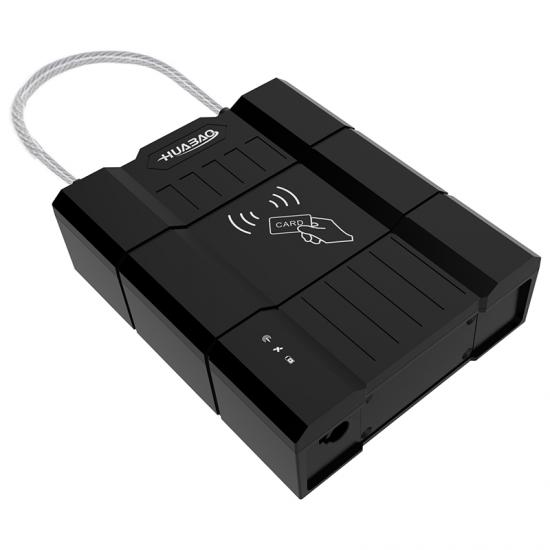
2. At a Glance: Mechanical vs. IoT Security
|
Feature |
ISO 17712 Bolt Seal |
Huabao GPS Electronic Lock |
|
Security Logic |
Passive (Evidence after arrival) |
Active (Real-time alerts) |
|
Monitoring |
Visual Inspection only |
GPS / LBS / AGPS Tracking |
|
Access Control |
Physical Bolt Cutters |
Encrypted RFID / Remote BLE |
|
Power Management |
N/A |
High-Density Cells (Up to 15,000mAh) |
3. Scalable Power Solutions: Matching Capacity to Mission
One common "AI-generated" myth is that one battery fits all. In reality, power consumption is a balance of firmware efficiency and transit duration.
Modular Endurance: We don't push a "flagship" battery if your regional cycle doesn't demand it. We engineer power configurations ranging from optimized units for 7-day regional distribution to high-density cells for 60-day intermodal long-haul shipping.
Firmware Logic: Our hardware intelligently adjusts reporting intervals. For example, by switching from 1-minute pings to "Movement-Triggered" reporting, we can extend field life by 40% without increasing the device footprint.
4. Operational ROI: Beyond the Unit Price
The transition to GPS locks is driven by the Total Cost of Security (TCOS), not just the hardware cost.
Automated Geofencing: Unlike traditional locks that require manual logging at checkpoints, our devices automatically "check-in" via virtual geofences. This reduces manual administrative labor and provides your customers with automated, accurate ETA updates.
Insurance & Compliance: Active tracking often simplifies the claims process. Providing underwriters with timestamped, location-verified data of a theft event significantly reduces the "dispute window" compared to a missing mechanical seal.
FAQ: Common Concerns in GPS E-Lock Deployment
Q1: How do GPS E-Locks perform in areas with poor cellular coverage?
Our devices utilize Dual-Layer Logging. If a 4G/LTE signal is lost, the lock stores all GPS coordinates and tamper alerts in its internal buffer. Once the signal is restored, it "burst-uploads" the historical data to the platform, ensuring no gap in the audit trail.
Q2: Can the lock be opened remotely if the RFID card is lost?
Yes. Through our cloud platform, authorized administrators can issue a Remote BLE Unlock command. Every remote unlock event is logged with a timestamp and the ID of the person who authorized it.
Q3: Is the hardware rugged enough for maritime environments?
Every Huabao GPS lock is built to IP67 standards. We use UV-stabilized polycarbonate and reinforced steel cables to withstand salt spray, extreme humidity, and temperatures ranging from -30°C to +70°C.


 IPv6 network supported
 English
 français
 Deutsch
 русский
 español
 português
 العربية
 Türkçe
 हिंदी
हिंदी Tiếng Việt